
Live capture · Cryptographic loop

Real take. Proven live.

TrueTake proves a video was filmed live. One phone shows QR codes signed by the server, the other films them: every code depends on the second before it. The result is a signed, anchored proof that anyone can verify.

See a verified proof
  • Ed25519 signatures
  • SHA-256 chain
  • Merkle anchoring
  • In-browser verification
  • No cookies

Every code depends on the second before it.

The problem

A video alone no longer proves anything.

Editing, generative AI, rewritten metadata: a video received after the fact no longer tells you when or how it was shot. That doubt weighs on everyone who has to decide based on evidence.

  • Generated footage

    AI tools produce convincing videos in minutes. Detectors play catch-up, with false positives.

  • Rewritten metadata

    Date, place, device: a file’s metadata can be edited with free software. It proves nothing.

  • Recombined sequences

    Real footage can be cut, reordered or replayed in front of a camera. Nothing shows it to the naked eye.

TrueTake doesn’t try to guess whether a video is fake. It proves the video was filmed live, inside a loop that cannot be prepared in advance.

Interactive simulator

Try the loop. Then break it.

This simulator runs in your browser with real SHA-256 (WebCrypto). Film segments, watch each hash go into the next QR code, then change a single byte of a video you already filmed.

Phone A · displaysCode 1

First code: no previous segment

Phone B · filmsREC 00.0

Aim at the code, then film

Segments 0 / 5

Film at least one segment before tampering with it.

The chain

  1. SEG 01to film
    segment
    —
    QR
    —
    chain
    —
  2. SEG 02to film
    segment
    —
    QR
    —
    chain
    —
  3. SEG 03to film
    segment
    —
    QR
    —
    chain
    —
  4. SEG 04to film
    segment
    —
    QR
    —
    chain
    —
  5. SEG 05to film
    segment
    —
    QR
    —
    chain
    —
Intact

Code 1 is showing on phone A. Film the first segment.

chainₙ = SHA-256(chainₙ₋₁ ‖ segmentₙ ‖ QRₙ)

Teaching simulation: the real app signs every QR code (Ed25519, COSE) and hashes canonical records (JCS). Nothing is sent anywhere; everything is computed in this page.

How it works

Four steps, no blind trust.

Two phones, a server that signs and a public ledger. Every step leaves a trace that anyone can recompute.

  1. Pair

    Open TrueTake on both phones — the one you aim films

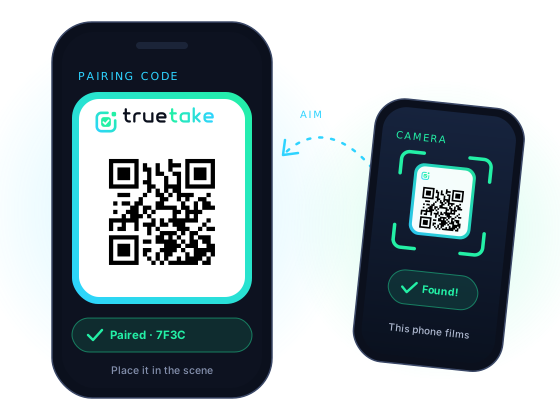
    One button, no role to choose. Each phone shows a pairing code and looks through its camera. Aim one at the other: the phone that reads the code becomes the camera, the other one will show the signed codes. Put it in the scene and step back: the capture starts by itself once you hold still, without filming the set-up.

    • Roles assigned automatically
    • Single-use pairing code
    • No account needed
    Two phones each show a framed TrueTake pairing code; the one aimed at the other becomes the camera.
  2. Loop

    Every code depends on the second before it

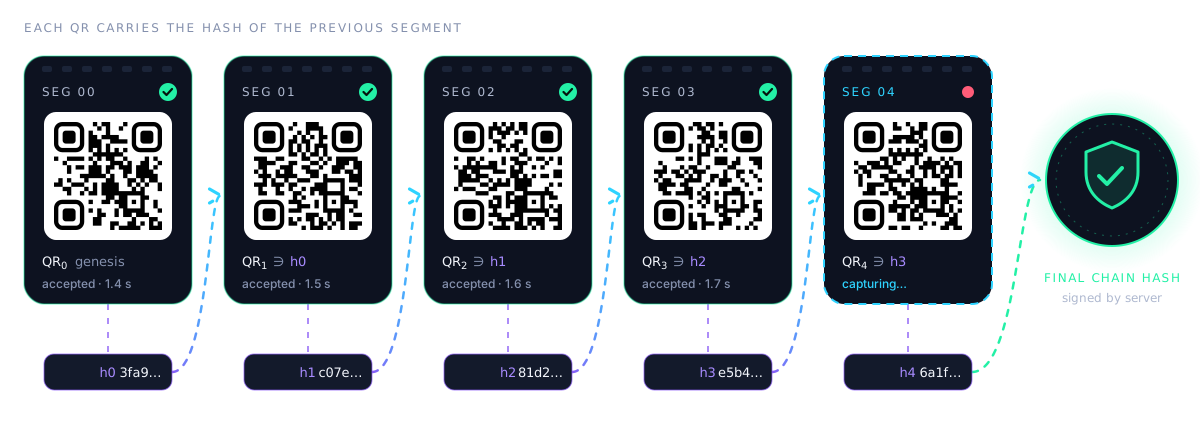
    A shows a QR code signed by the server. B films a segment of about one second, chains it to the previous ones and uploads it. The server checks the right code is visible, then issues the next QR code, which commits to that chain. The loop runs until you stop it, and the history is signed as you film.

    • Ed25519-signed QR codes (COSE)
    • 20 seconds of validity per code
    • Up to 30 minutes per capture
    Video segments chained by their hashes up to the final chain hash.
  3. Seal

    A signed, analysed proof

    At the end, the server assembles the video, runs eleven consistency checks and signs a certificate that commits to the signed history of the capture, its live coverage and the final file.

    • Ed25519 certificate
    • Forensic report included
    • Final video hashed (SHA-256)
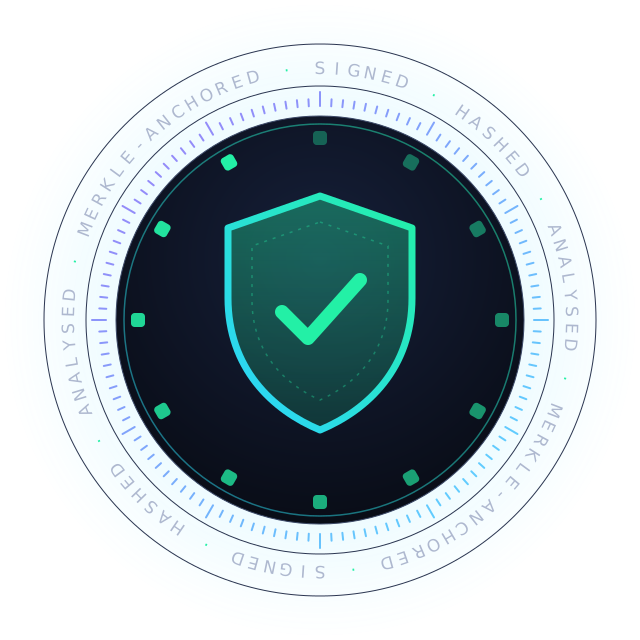
    A seal: signed, hashed, analysed, Merkle-anchored.
  4. Anchor

    Published in a public ledger

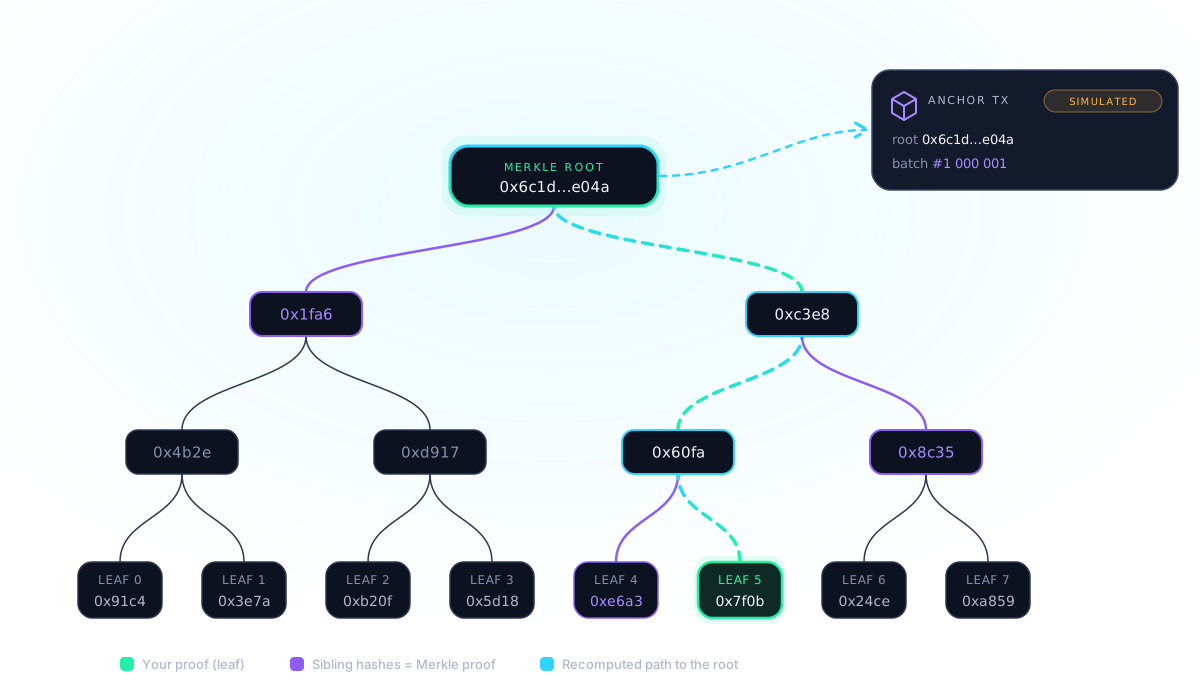
    The certificate hash becomes a leaf of a Merkle tree. The root is published in batches in the TrueTake public ledger (a simulated network during the beta); once anchored on a public network, it dates the proof without revealing anything about it.

    • truetake-merkle-1 scheme
    • Browsable public ledger
    • Simulated network in beta, testnet optional
    A Merkle tree: the proof leaf and its siblings lead up to the anchored root.

What we prove

Live capture, proven by cryptography. Faking it, made very hard.

Recorded in real time: a mathematical proof, not a score

For every segment a valid proof counts as filmed live, with no estimate or probability; the signed history is recomputed in the verifier:

  • Not before its code. Each live segment (0.7 to 2 s) shows a QR code signed by the server (Ed25519) that carries a 128-bit random number drawn when it was issued. It could not be known earlier: the segment cannot have been produced before.
  • Not after the next code. The next QR code commits to the chain of the segments received, each with its SHA-256 hash: that segment already existed, byte for byte, and can no longer be retouched or replaced.
  • Within seconds. A segment sent after its code expired (20 s), or longer than the time between the code being issued and the segment being received, is refused. A capture lasts 30 minutes at most, on the server clock.
  • In order, with every interruption shown. Each code is used once and every segment is chained to the one before: no reordering, nothing slipped in afterwards. A segment whose code cannot be read is kept but not counted as live. An interruption (a call, the network, at most three) is declared and appears on the certificate with its duration: no cut is hidden.
  • Untouched since signing. The signed certificate commits to the hash of the final video and to the whole chain: change one byte and verification fails.

These guarantees rest on Ed25519, SHA-256 and the server: its key, its clock, its reading of the code in the frames. They establish when and in what order the video was recorded, not that the scene is true.

A screen filmed in the background? What we put in place

The most elaborate scenario: filming, live, a screen playing a generated scene, with phone A’s codes in the frame. Our checks impose heavy constraints on it:

  • The code and the scene in the same frame. The server must read the code in the frames of the segment, and the filming phone never receives it over the network: the app can only film it, with the scene.
  • No retouching after upload. Adding, replacing or recomposing frames after upload changes the segment hash and breaks the chain; before it, only the seconds the code is valid remain.
  • The camera, nothing else. The app records from the camera and imports no file; the server refuses a segment whose declared source is not the camera.
  • A video measured segment by segment. Duration, resolution, codec, frame rate, clocks, delays, code visibility: every measured deviation appears in the report attached to the certificate.
  • The phone’s motion, sealed. If you allow it, the motion intensity of the filming phone (accelerometer, gyroscope) and an approximate place are sealed in the chain for each segment.
  • A video open to inspection. Built from the accepted segments only, the certified video can be scrutinised by anyone with access: screen edges, reflections, moiré, flicker.

To be clear: no automatic detector of filmed screens or generated images is active today; these analyses are planned.

An AI detector estimates a probability, after the fact. TrueTake establishes the proof while the video is being shot, and anyone can verify it. To pass off a generated video, one would have to produce it live, with phone A’s codes in the picture, segment after segment. Without making fakes impossible, TrueTake makes them very hard: we therefore consider it the most reliable way today to show that a video was filmed live rather than generated.

Use cases

Wherever a video has to stand up to doubt.

  • Insurance and claims

    Water damage, a damaged vehicle, the state before works: the policyholder films, the adjuster checks the video really dates from the claim.

    What the proof addsFilmed live, at server time, not recombined.

  • Journalism and OSINT

    A witness films while a remote reporter shows the codes. The newsroom publishes the video with its verification link.

    What the proof addsNo sequence prepared in advance or injected.

  • Delivery and hand-over

    The courier shows the parcel, the customer shows the codes: the hand-over is documented in a minute, without paper.

    What the proof addsBoth parties took part, at the same moment.

  • Bailiffs and legal officers

    Alongside an official report, a recording every party can verify, with its hash chain attached to the file.

    What the proof addsEvery segment linked to the previous one, file intact.

  • Inspections and check-ins

    Building sites, rentals, quality checks: the inspector and the other party produce a shared, time-stamped record.

    What the proof addsServer time-stamp and capture context.

TrueTake produces technical evidence. Its legal weight depends on the context and on the judgement of those who examine it.

Trust and technology

What the proof guarantees. And what it doesn’t.

What TrueTake proves

  • The video was captured during the loop, segment by segment, in order; any interruption is declared, with its duration.
  • Each segment counted as live was recorded between the issue of the code it shows and the issue of the next one: it cannot be prepared in advance or retouched afterwards. The certificate shows how much of the capture was filmed live.
  • The final file has not changed since it was signed (SHA-256 hash).
  • The certificate is signed by a published TrueTake key and belongs to a batch anchored at a given time (TrueTake ledger during the beta).

What TrueTake does not prove

  • That the filmed scene is true: staging in front of the camera, including a screen filmed in the background, remains possible. Our checks make it hard without ruling it out.
  • That no image was generated: no automatic AI detector is active today.
  • Who is holding the phones.
  • An exact position: the place, when you allow it, is deliberately approximate.
  • Hardware integrity of the devices: device attestation is not available yet.

Open standards, recomputable by anyone

  • Ed25519signatures
  • SHA-256hashes
  • JCSRFC 8785
  • COSE_Sign1RFC 9052
  • Base45RFC 9285
  • CBORRFC 8949
  • Merkletruetake-merkle-1
  • Forensics11 heuristics
  • Local verification: your files never leave your device.
  • No cookies, no ads, no third-party CDN: only anonymous audience measurement.
  • Location and sensors are optional and reduced to coarse values.

Read the technical documentation

Live proof

A real proof, verifiable right now.

The TrueTake server runs a demo operation end to end: real signed QR codes, real videos, the real chain, a certificate signed then anchored. Open it in the verifier and watch every check pass.

API unreachable · static sample

Frozen sample shown because the API is not responding. Real values appear as soon as it is reachable.

Demo proof

Anchored Simulated network Synthetic demonstration

Demo being generated

Proof hash
6c1d·3fa9·…·e04a
Video SHA-256
9f3a·e07b·…·c41e
Segments
5
Filmed live
6.012 s
Signing key
tt-ed25519-3fa9c07e81d2e5b4
Signed on
16 Oct 2026, 08:00 UTC
Analysis
No significant anomaly
Coherence
94.4%

Proofs issued

128

Proofs anchored

127

Batches published

41

Last anchor

16 Oct 2026

Excluding demos

Public ledger

The last 5 anchored batches

  1. 6c1d·3fa9·…·e04a3 leaves#1,000,041
  2. 81d2·c07e·…·d9171 leaf#1,000,040
  3. e5b4·d917·…·e04a4 leaves#1,000,039
  4. 3fa9·a41f·…·c07e2 leaves#1,000,038
  5. a41f·9c02·…·3fa92 leaves#1,000,037

FAQ

What people ask us before their first capture.

Do I really need two phones?

Yes. One shows the codes, the other films: these two separate roles make the loop impossible to prepare alone in advance. You have nothing to choose: open TrueTake on both, and the phone you aim at the other becomes the camera. Each phone only needs the app and an internet connection.

How long does a capture take?

As long as you need, up to 30 minutes: you can finish once at least five seconds have been filmed live, over three codes. Each code stays valid for 20 seconds. Once the phones are paired, you have two minutes to frame the scene: the capture starts by itself as soon as you hold still, and nothing is filmed before.

Does TrueTake detect deepfakes?

Not with a detector, and we don’t claim to. TrueTake turns the problem around: it proves that every segment counted as live was recorded inside the loop, which rules out a video edited after the fact. That leaves faking it live, such as a filmed screen: we make it very hard, not impossible (what we put in place). The forensic checks are consistency heuristics, not AI detection.

Who can verify a proof?

Anyone, without an account. The verifier runs in the browser: drop the proof file and the video, and every check is recomputed locally. Only the public keys and the anchor batches come from the public API.

Are my videos sent to the server?

During capture, yes: the server reads each segment to check the visible code, then assembles the final video. It is kept for a limited time (see the privacy policy). When you verify, however, your file never leaves your device.

What does “simulated network” mean?

During the beta, Merkle roots are published in the TrueTake public ledger with a simulated, recomputable transaction, not on a public blockchain. The verifier says so clearly instead of hiding it behind “valid”. Anchoring on a test network (Base Sepolia) is available as an option.

What if the network drops during capture?

Each segment is uploaded as soon as it is filmed, and the history is signed as you go. If the network drops, a call comes in or the app goes to the background, the capture is interrupted: you have two minutes to resume it, at most three times, and each interruption appears on the certificate with its duration. Without a resume, the capture ends by itself and is certified only if at least five seconds were filmed live.

What is a TrueTake proof worth legally?

It is technical evidence, documented and verifiable by third parties. Its weight depends on the context and on the judgement of those who examine it. TrueTake does not replace a public officer.

Is there an iPhone app?

An Android test build is available (Android 10+). The iOS version is in preparation: drop us a line from the download page to be notified.

Your next video deserves a proof.

Install TrueTake on two phones and produce your first verifiable proof in under a minute.